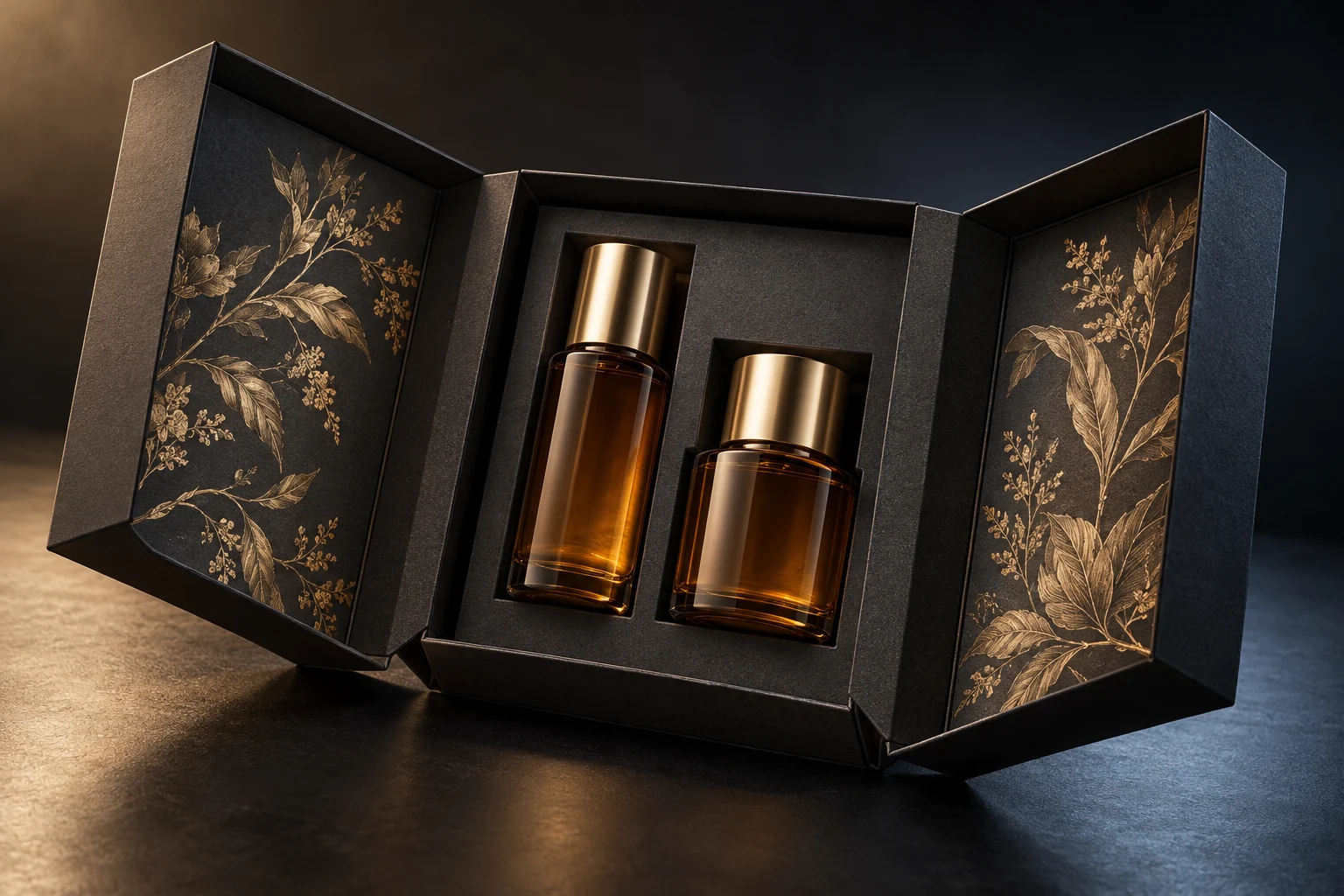
Folded covers, not flat doors
Each wing combines a main cover panel with return walls. Those returns create the architectural silhouette, but also occupy space as the cover moves. Map the opening arc against the bottles, the base rim and the opposite wing. A hinge that looks correct in a render can still rub the wrapped corner in a physical sample.
Design the opening around the filled product
Measure the bottle at its widest point, including the cap, and use its packed weight. A decorative recess should locate the bottle without gripping the label or loading the cap. Check both the presentation position and the route the customer uses to lift it out. Finger access belongs in the insert design from the start.
Make the centre panel part of the system
A raised centre panel gives the identity a clear focal point. Its height must be considered alongside the insert, the bottle caps and the closed covers. Locate an applied emblem positively; decide whether it is decorative, removable or permanently fixed, and review the fixing method in the sample.
Give the foil a realistic boundary
Botanical foil can travel across folded panels, but fold lines and paper texture influence what can be reproduced cleanly. Keep critical fine lines clear of hinge zones. Review the actual die, foil tone and stock together, including whether the design continues across the closed wings.
PHYSICAL SAMPLE REVIEW
What to check before approval.
- Cycle both wings and inspect hinge, return-wall and bottle clearances.
- Load the real products; test removal without marking the labels.
- Check the centrepiece height with the covers fully closed.
- Compare foil coverage and edge definition under neutral light.
- Review the packed shipping carton separately from the presentation box.