01
Luxury velvet
A dense pile creates a soft interior for jewellery and delicate gifts.
Review pile direction, colour transfer and contact with the product. Fabric-wrapped insert work is externally sourced.
A LANGUAGE YOU CAN FEEL
Compare paper, textile and specialist surface directions, then confirm availability, sourcing and suitability with physical references.
PAPER, TEXTILE & SURFACE
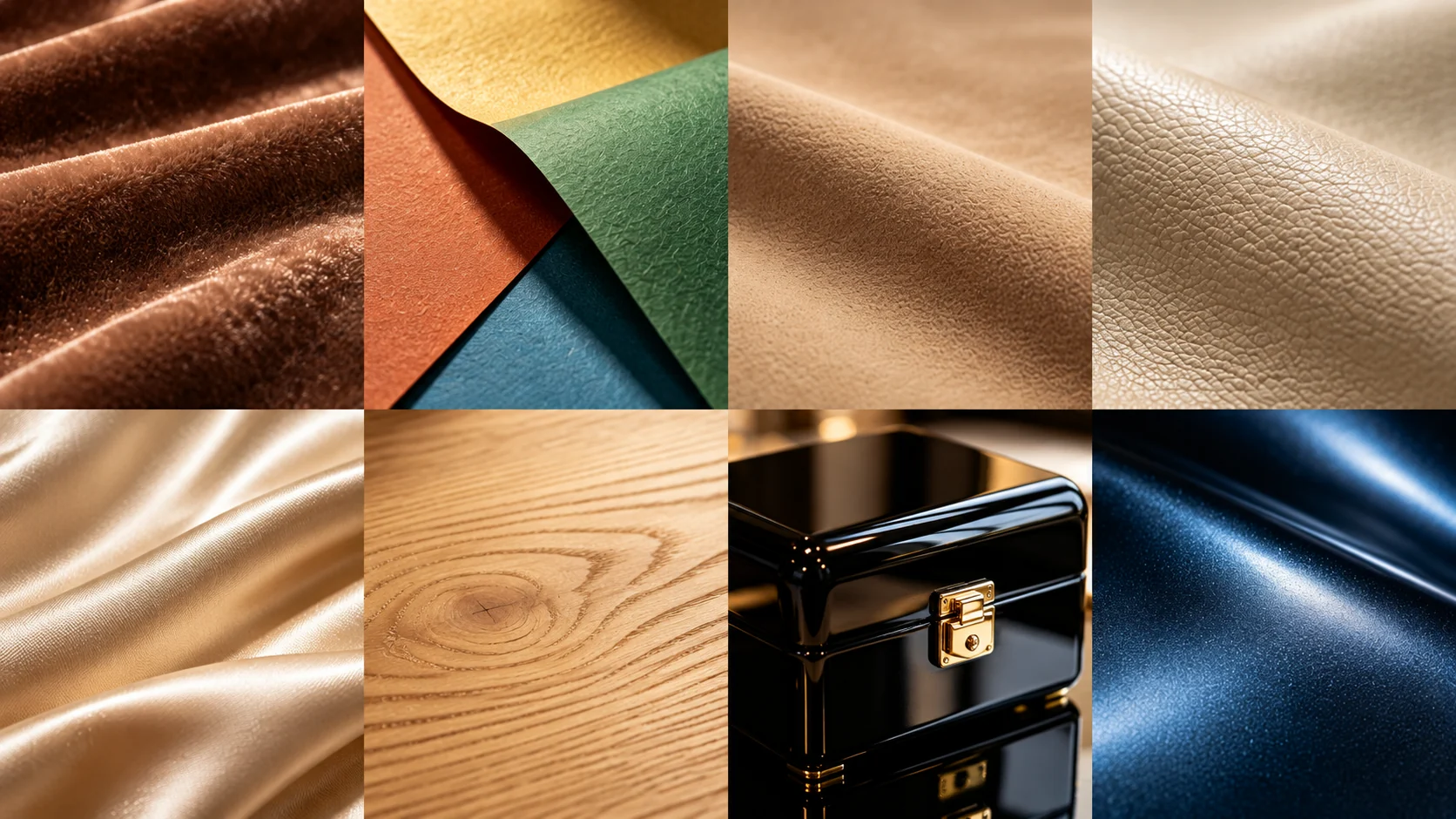
Explore eight material and surface directions, then develop the specification around your product, construction and disposal requirements. These AI-generated illustrations show texture and appearance; they are not stock samples, factory photographs or proof of in-house processing.
01
A dense pile creates a soft interior for jewellery and delicate gifts.
Review pile direction, colour transfer and contact with the product. Fabric-wrapped insert work is externally sourced.
02
Colour, fibre and embossed textures can carry a brand before any ink is applied.
Sample foil and fine print on the actual stock; confirm grain and wrapping behaviour.
03
A fine suede-like nap offers a restrained lining or wrapped-surface direction.
Check abrasion, shade consistency and the fixing method; textile sourcing is confirmed for each project.
04
Embossed grain and a structured surface suit reusable presentation concepts.
PU is a synthetic material. Review edge wrapping, adhesion and material-separation requirements.
05
A smooth lustre can add drape and a ceremonial feel to an interior.
Check snagging, seams and dye transfer. Fabric-wrapped inserts are handled by specialist external partners.
06
Natural grain offers a different visual direction from a conventional paper wrap.
Discuss construction, sourcing and weight first. No certified or eco-friendly claim is implied by this image.
07
A deep reflective finish can create a polished presentation-case concept.
This is a surface treatment rather than a paper grade. Confirm substrate, process sourcing and sample feasibility before specifying.
08
Reflective metallic-effect surfaces add a controlled highlight to selected areas.
Distinguish metallic paper, foil and coatings. Approve the actual sample rather than a screen colour.
THE PAPER FOUNDATION
Our regular paper categories include greyboard, coated art paper, white card and kraft paper. Greyboard thickness ranges from 1 to 4 mm; the chosen combination depends on panel size, product weight and the opening construction.
Core printing, finishing and box assembly are managed in-house. EVA, foam, paperboard and vacuum-formed inserts are made in-house; fabric-wrapped inserts use specialist external partners.
Full-coverage foil, embossing, varnish and spot UV are available within the agreed specification. Film lamination is not our default recommendation where reducing mixed layers is a priority; discuss paper and coating alternatives while retaining the required protection.
Wood, PU and specialist lacquer directions require a project-specific sourcing and feasibility review. Material availability does not establish FSC, recycled-content, food-contact or recyclability claims; request evidence for the exact component and destination.
Explore printing and finishingRequest a physical material referenceStructural board, wrapping paper, lining and decorative surface treatments serve different purposes. The eight directions above are illustrative, not a stock list. Confirm the actual construction, sourcing and physical reference for your project.
Review paper selectionYOUR NEXT STEP
Compare paper, textile and specialist surface directions, then confirm availability, sourcing and suitability with physical references.
RESOURCES & INSIGHTS