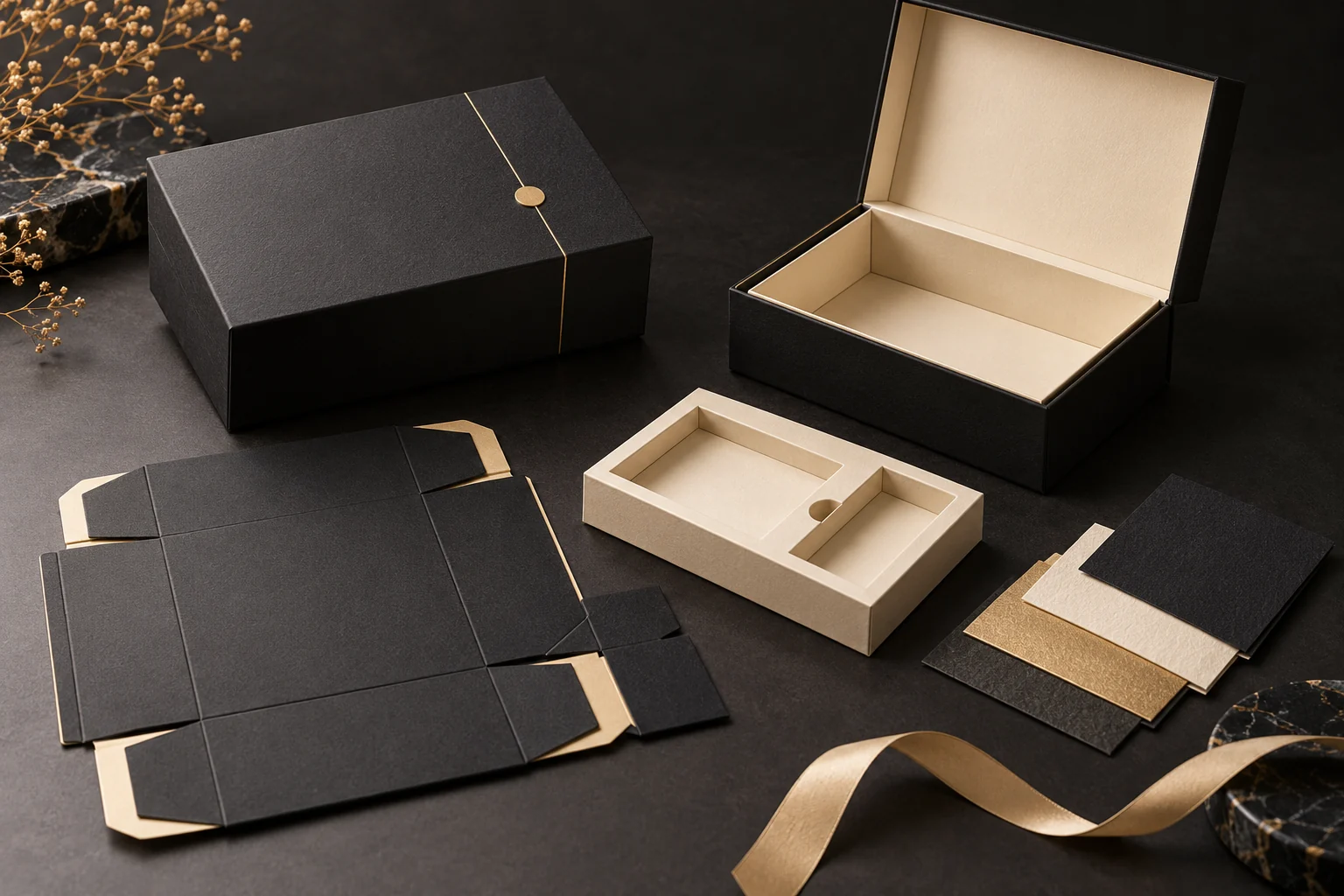
02 / 01
Define what must stay
Start with the real products and their journey. Identify protection, usable fit, easy removal, key brand details and any agreed project requirements. Put each decision in one of three groups: fixed, adjustable or needs validation.
This prevents a lower unit price from removing the feature that makes the packaging useful. Agree the priorities with everyone who will approve the revised sample.
02 / 02
Review dimensions and construction first
Measure the actual product, including its cap, pump and accessories. Review unused space, set layout, opening method and packing sequence. A simpler structure may be worth comparing, but reducing board thickness or clearance without checking performance can create a new problem.
Compare rigid box structures ↗02 / 03
Review paper and decoration as a combination
Compare wrapping papers, print requirements, foil coverage and the number of decorative operations. Ask what the actual paper, artwork scale, quantity and tooling imply for the production route. No one finish is always the cheapest choice.
Keep the detail that carries the identity, then sample any changed paper or finish. A photograph cannot confirm texture, foil behaviour or the effect of relief on the selected stock.
Explore material directions ↗ · Compare foil and relief ↗02 / 04
Include inserts, cartons and assembly
Choose the insert around restraint, surface contact, removal and assembly. Paperboard, EVA and other options need project-specific comparison; paper does not automatically mean lower cost or adequate protection.
For fold-flat options, compare the actual carton dimensions and quantities with the labour and space needed for assembly. Separate the presentation box from its transit packaging. Freight savings require real packing data and a relevant freight quote.
Review insert decisions ↗ · Explore collapsible rigid boxes ↗02 / 05
Compare the benefit and the trade-off
| Review area | Change to compare | Possible trade-off | Validation needed |
|---|---|---|---|
| Structure / dimensions | To confirm | Fit, opening, strength | Structural sample |
| Paper / decoration | To confirm | Appearance, texture, fine detail | Physical finish sample |
| Insert / layout | To confirm | Restraint, removal, packing | Sample with real products |
| Flat / assembled delivery | To confirm | Labour, carton size, storage | Packing data and assembly review |
Record Option A and Option B using the same quantity, currency and delivery scope. Add the actual quotation and any buyer-side assembly or logistics costs separately. No saving percentage can be established from appearance alone.
02 / 06
Approve the revised specification
Record each change, the reason and what the physical sample confirms. Update the artwork revision, material references, quote and schedule together. A cost review is complete when the revised packaging meets the agreed requirements.
Plan the sample approval ↗A TOOL FOR YOUR OWN PROJECT
Your cost review worksheet
Blank planning worksheet. Enter your own project information; no example prices, savings or promised dates are supplied.
Download the blank worksheet · English CSV ↓Open in a spreadsheet application. The website does not collect or save your entries.
Planning guidance based on Suiyuan’s confirmed business information. Project specifications, commercial terms and dates are confirmed in the written quotation and order agreement. Worksheets are blank tools, not client case records.