Start with the weight and shape
List every item, including accessories, and measure its widest point. A filled glass bottle needs different support from a silk scarf. Decide what the customer should see first when the box opens.
Choose the opening experience
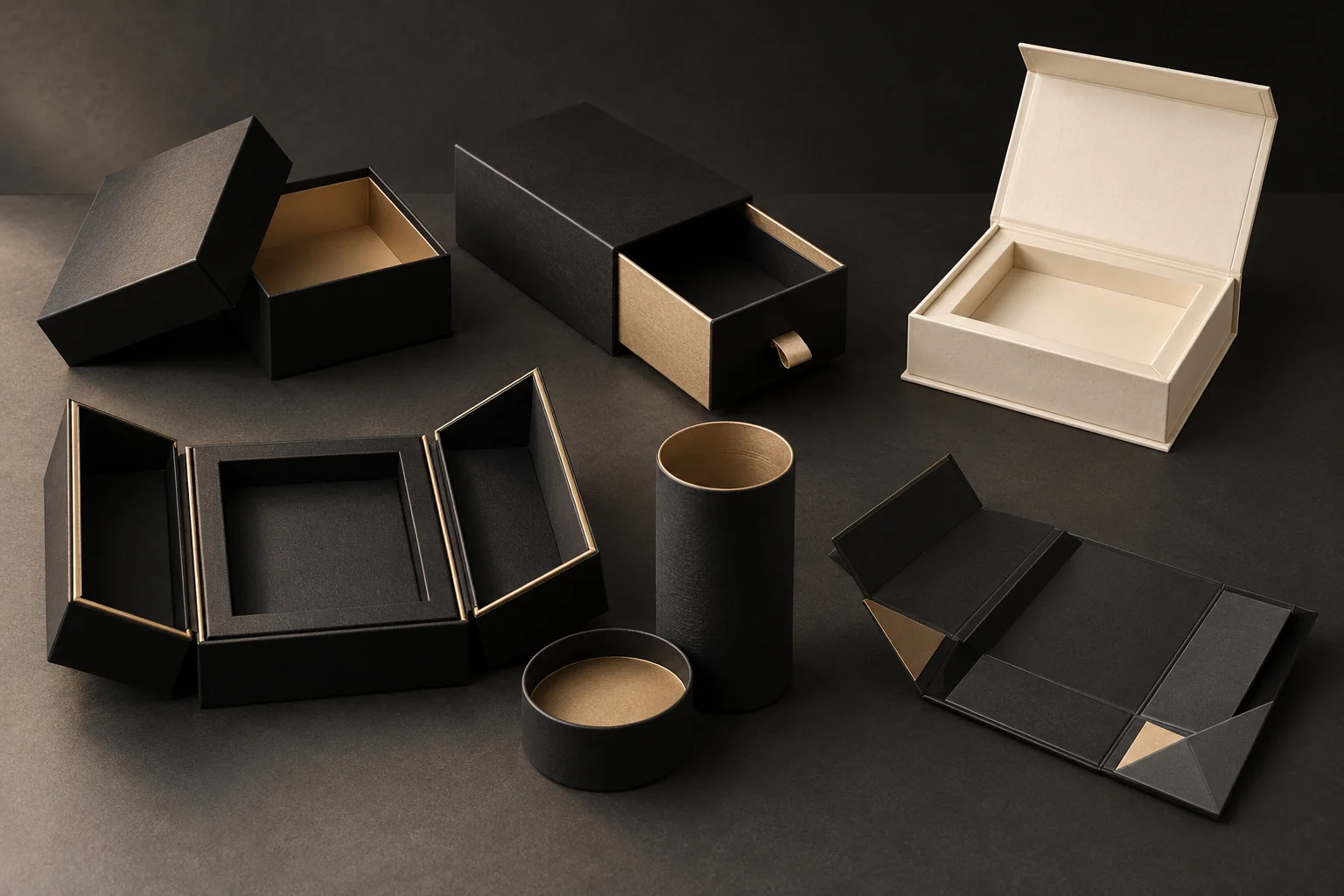
A lid-and-base box is familiar and versatile. A drawer creates a slower reveal. A magnetic box offers a generous inside-lid canvas. Double-wing structures are especially effective for symmetrical gift sets.
THE DECISION TO KEEP
The right structure serves the product and its journey. A more elaborate opening is useful only when it improves the complete experience.
Account for storage and assembly
Fold-flat constructions can reduce unassembled storage volume, but somebody must assemble them. Compare freight, packing time and structural needs together.
Approve a structural sample
Check fit, opening force, finger access and the packing sequence with real products. Resolve structural issues before investing in final decoration.
A PRACTICAL DECISION REFERENCE
Compare the entire experience.
| The decision | What to identify | What to review |
|---|---|---|
| Lid & base | Familiar lift-off reveal | Lid depth, opening force and product support |
| Drawer & sleeve | Compact, deliberate sliding opening | Slide tolerance, pull detail and surface contact |
| Magnetic closure | Inside-lid storytelling and a clean close | Flap alignment, magnet positions and packed clearance |
| Double wing | Balanced multi-product gifting | Moving cover arcs, folded returns and insert access |
| Cylindrical | A silhouette that echoes a jar or vessel | Seam, diameter, lid fit and vertical restraint |
| Collapsible rigid | Reduced unassembled storage volume | Corner fixing, packing labour and shipping format |
Start with a packing sketch
Draw the main product, accessories and supporting cards in the position you want the customer to see. Mark the packed dimensions and filled weights. This simple map helps identify whether the opening should lift, slide or unfold, and whether the package needs one deep compartment or several independent locations.
Ask for alternatives that solve the same brief
A comparable quotation should keep product configuration, protection and delivery responsibilities consistent. If one option uses a different paper, insert or decorative process, make the change explicit. A lower unit price does not by itself establish a better landed cost or a better customer experience.
A Suiyuan packaging development guide. Confirm order-specific values, material evidence and approval criteria with the factory team.
KEEP EXPLORING
Return to the illustrated notebook